- Share
- Share on Facebook
- Share on LinkedIn
Seminar
On 10 February 2026
Saint-Martin-d'Hères - Domaine universitaire
Registration is required:
https://docs.google.com/forms/d/e/1FAIpQLSdVQvVkq_z19AtYzfS_zYNVoj7mO-1JDwlH2_XQK-5AUf4dKQ/viewform?usp=dialog
Seminar program:
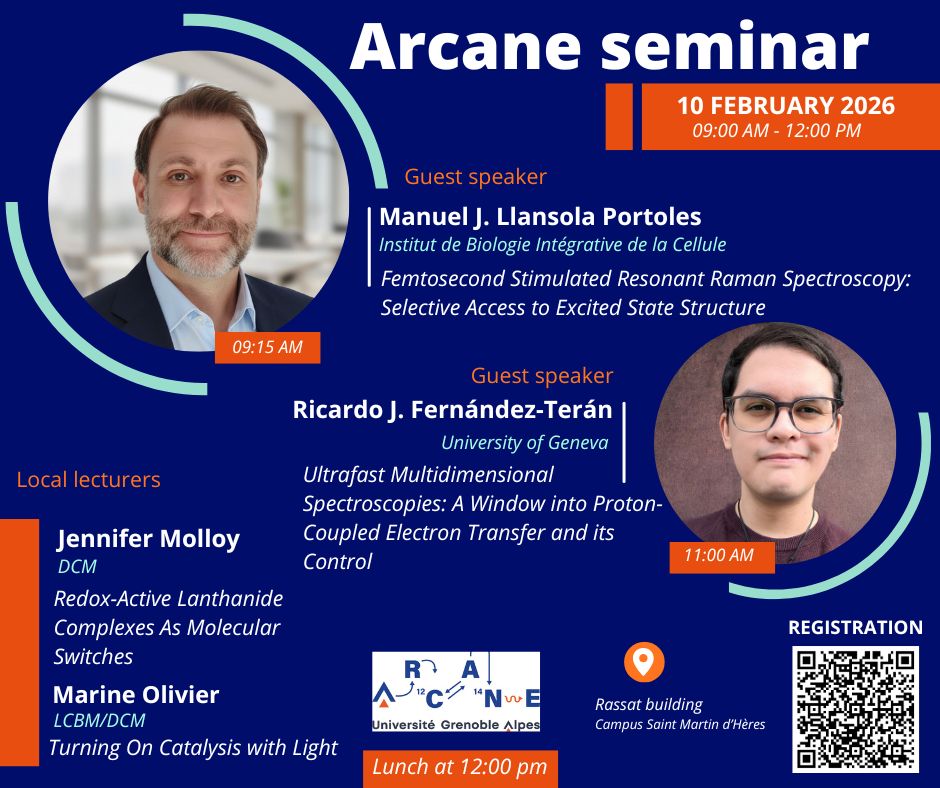
9 am - 9:15 am Marine Olivier (LCBM/DCM)
"Turning On Catalysis with Light"
9:15 am - 10:15 am Manuel J. Llansola Portoles (Institut de Biologie Intégrative de la Cellule)
"Femtosecond Stimulated Resonant Raman Spectroscopy: Selective Access to Excited State Structure"
Excited states govern the earliest steps of solar energy conversion, yet we still lack robust strategies to control and exploit their structure in complex molecular systems. Photosynthesis remains an exceptional source of inspiration: pigment–protein assemblies capture light with remarkable efficiency and can rapidly switch to safe dissipation under excess illumination, but the molecular mechanisms behind these functions are not fully understood. Here I introduce Femtosecond Stimulated Resonant Raman Spectroscopy (FSRRS), an ultrafast vibrational method we have installed in my lab to selectively interrogate specific excited species within dense, overlapping manifolds. By combining femtosecond time resolution with resonance enhanced Raman sensitivity, FSRRS provides state specific vibrational fingerprints that complement and extend conventional electronic spectroscopies. Using photosynthetic chromophores and antenna complexes as testbeds, we show how these fingerprints can be used to trace energy flow and identify structural motifs linked to transfer and quenching. Finally, I will show how the same state selective vibrational approach can be applied to artificial photoactive assemblies and photocatalysts to resolve competing excited state pathways and guide more robust design.
10:15 am - 10:30 am Coffee break
10:30 am - 11 am Jennifer Molloy (DCM)
"Redox-Active Lanthanide Complexes As Molecular Switches"
11 am - 12 pm Ricardo J. Fernández-Terán (University of Geneva)
"Ultrafast Multidimensional Spectroscopies: A Window into Proton-Coupled Electron Transfer and its Control"
Controlling excited-state reactivity by bond-specific IR excitation is an active and fundamental field of research.[1,2] Our group is focused on the application of ultrafast multidimensional spectroscopies to address critical issues in proton-coupled electron transfer (PCET).
In this talk, I will show examples of our ongoing research towards the study and control of excited-state photoreactivity, including electron and charge transfer, excited state symmetry breaking (ES-SB), and proton transfer, in a series of organic and organometallic chromophores—all under the umbrella of controlling PCET reactivity with light.
We have previously shown how remote substitution can be used to tailor the excited-state character in Re(I) carbonyl complexes,[3,4] illustrating the power of transient IR spectroscopy to address electron and charge transfer, as long as suitable vibrational markers are present in the molecules of interest.
Our current work includes the study of donor–acceptor–donor (D–A–D) chromophores which exhibit ES-SB upon photoexcitation.[5,6] Using transient IR and transient 2D-IR spectroscopies, we examine the effect of selective IR excitation of the C≡C stretching modes of the π bridge in the electronically excited state, whilst also gaining unique insight into the excited state vibrational landscape. In the second stage, we modified these chromophores, introducing intrinsic rotational asymmetry, observing some intriguing differences. In a third step, we aim to understand the role of the overall redox state of the molecule in the ES-SB dynamics—akin to inorganic mixed-valence complexes.
In parallel, we examined the photodynamics of symmetric Pt(II) bis-acetylide complexes with either a cis- or trans- arrangement of the two acetylide ligands, investigating also the role of the conjugation length and electronic properties of the substituent on the ligand framework.[7]
By focussing on the C≡C stretching modes (1950–2250 cm–1), which directly participate on the electron/charge transfer pathways, we can gain a unique perspective. We combine these spectroscopic methods with calculations, (spectro)electrochemistry and the design and synthesis of new molecules.
One last system we examined involves proton transfer (PT) in a symmetric molecule with two independent PT sites. In this case, a single-sided ultrafast excited-state intramolecular PT reaction takes place, followed by isomerisation. Multipulse experiments enable us to observe the ground-state back PT reaction, and to investigate the effects of a secondary trigger into the potential for driving a second PT reaction.
Altogether, we observe a marked solvent dependence of the ES-SB dynamics of the organic D–A–D system, however with a lack of “permanent” control over the outcome of the photoexcitation process. Ongoing investigations into other organic and organometallic systems will provide further answers on the generality of this approach, whilst providing design criteria for functional molecules and materials.
Funding: Swiss National Science Foundation, Ambizione grant PZ00P2-216249. The University of Geneva is also acknowledged for financial support.
Acknowledgement: I warmly thank Prof. Dr. Eric Vauthey for hosting my research group and for helpful discussions, as well as our international collaborators.
References:
[1] R. J. Fernández-Terán, CHIMIA 79, 744–748 (2025).
[2] Delor, M., Weinstein, J. A., et al. Science 346,1492-1495 (2014).
[3] R. J. Fernández-Terán, L. Sévery, Inorg. Chem. 60, 1325–1333 (2021).
[4] R. J. Fernández-Terán, L. Sévery, Inorg. Chem. 60, 1334–1343 (2021).
[5] Dereka, B., Vauthey, E., et al. Nat. Commun. 11, 1–11 (2020).
[6] Dereka, B., Rosspeintner, A., Li, Z., Liska, R. & Vauthey, E. J. Am. Chem. Soc. 138, 4643–4649 (2016).
[7] J. C. López-López, Y. H. Nguyen, C. Jiang and T. S. Teets, Inorg. Chem. 62, 17843–17850 (2023).
12 pm Lunch
Date
from 9 am to 12 pm
Localisation
Saint-Martin-d'Hères - Domaine universitaire
Rassat building: 470 rue de la Chimie, Gières
- Share
- Share on Facebook
- Share on LinkedIn