
MEM
- Share
- Share on Facebook
- Share on LinkedIn
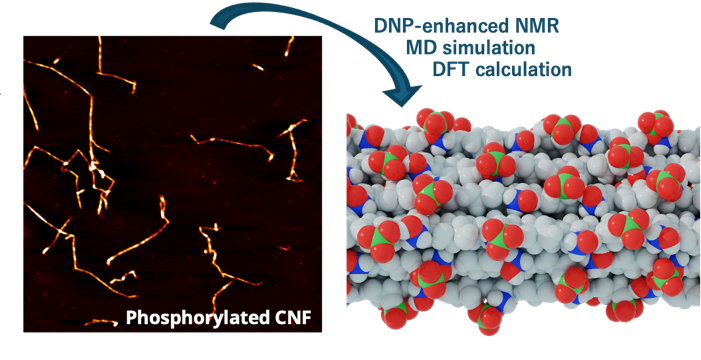
Atomic-level details of nanocellulose structure, particularly at its surface, remain difficult to resolve and are therefore poorly understood. Here we apply dynamic nuclear polarization (DNP)-enhanced solid-state NMR to directly probe the surface chemistry of phosphorylated cellulose nanofibers. We were thus able to determine precise phosphate substitution sites on C2 and C6, the degree of phosphorylation, and the conformational distribution of surface phosphate groups with their corresponding spatial distribution. Information gained from DNP-NMR data was used to construct a CNF model for MD simulations, which reproduce the fibril twisting observed by AFM. To rationalize the preferred conformations of phosphorylated C6 groups observed in both NMR experiments and MD simulations, DFT calculations were carried out and show that these conformations are governed by facet-dependent hydrogen-bond formation at the nanocellulose surface.
Atomic structure of phosphorylated nanocellulose revealed by dynamic nuclear polarization-enhanced solid-state NMR, T. Yagita, S. Paul, W. Papawassiliou, A. Sakiyama, Y. Tomita, T. Saito, S. Hediger, G. De Paëpe, and S. Fujisawa, J. Am. Chem. Soc. 2026, 148, 4237−4249. DOI: 10.1021/jacs.5c17152.
- Share
- Share on Facebook
- Share on LinkedIn